Mountaineering School in Ecuador | 12-Day Course – AIMS
Overview
- Duration: 12 Days / 11 Nights
- Difficulty: Moderado [icono_lvl2]
- Season: Nov - Feb
Description
Twelve days from landing to departure, built in three blocks. The school starts on Day 2, before any climbing: a full day at the Ilinizas Mountain Lodge going through every piece of equipment you will use on the course — for rock, for snow and for ice — and then the rope systems, anchors, rappelling and companion rescue that the rest of the program depends on.
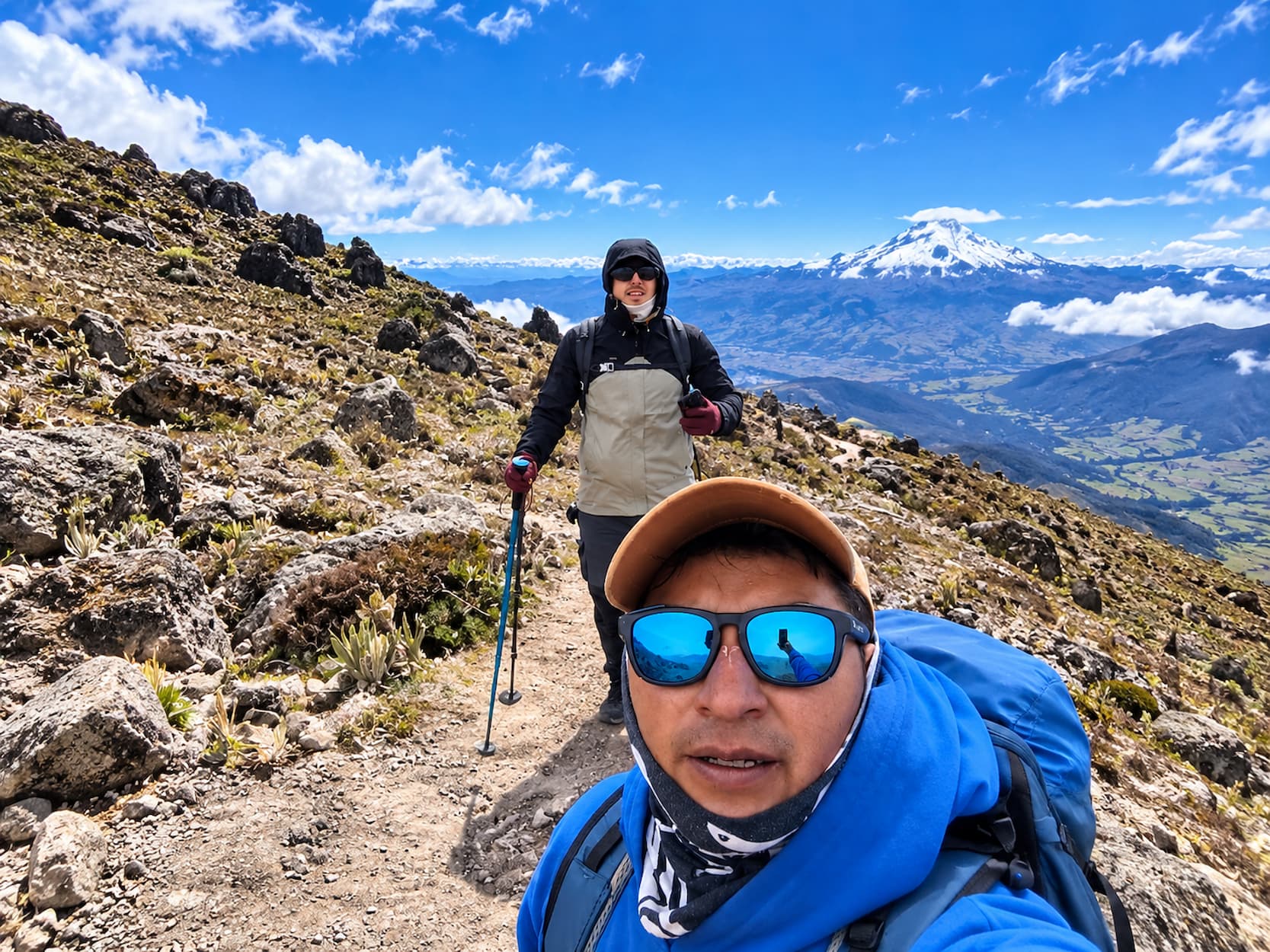
Santa Cruz on Day 3 is the first altitude day. Iliniza Norte follows over two days, sleeping at the Nuevos Horizontes Refuge at 4,700 m and climbing to 5,126 m on rock, which puts you above 5,000 m well before any glacier is involved. Days 6 and 7 move the school onto the Cayambe glacier, and Day 8 is the Cayambe summit.
Recovery happens at Papallacta, in the thermal springs on the eastern side of the cordillera, before the team returns to the lodge and finishes on Chimborazo: Carrel Refuge, High Camp at 5,300 m, and the summit at 6,268 m.
Itinerary
Day 01:Arrival & Transfer to Ilinizas Mountain Lodge
Pick-up at Quito International Airport and private transfer south along the Avenue of the Volcanoes to El Chaupi and the Ilinizas Mountain Lodge at 3,300 m / 10,827 ft, your base for most of the program. Around two hours on the road.The rest of the day is deliberately quiet: settle in, eat well and start hydrating at 3,300 m. In the evening your guide runs the full course briefing — objectives, the structure of the school, itinerary flexibility and safety protocols — and answers whatever you want to ask before the work starts.
- Altitude: 3,300 m / 10,827 ft
- Accommodation: Ilinizas Mountain Lodge
- Meals: Breakfast/Box Lunch/-
- Distance: 85 km
- Duration: 2 h
Day 02: Equipment Day: Rock, Snow and Ice
A full day at the lodge dedicated to the equipment. You go through every item the course uses and what each one is for on rock, on snow and on ice: mountaineering boots and crampons, ice axe, harness, helmet and personal anchor, ropes, carabiners and pulleys, ice screws, pickets and the crevasse-rescue hardware. Everything is fitted and adjusted to you personally.The rest of the day is rope systems on easy ground around the lodge: knots and rope handling, building and load-testing anchors, setting fixed ropes, rappelling, ascending a fixed line with mechanical devices, hauling systems, and simulated companion-rescue scenarios. The day is deliberately altitude-neutral. It lets you focus entirely on technique with immediate feedback from your guide, and it means nothing you pick up later in the program will be unfamiliar.
- Altitude: 3,300 m / 10,827 ft
- Accommodation: Ilinizas Mountain Lodge
- Meals: Breakfast, lunch, dinner
- Distance: ---
- Duration: ---
Day 03: Santa Cruz
Your first acclimatization climb, on the high ground above El Chaupi. The route is technically straightforward by design, which is exactly what the third day in the country calls for: the purpose is to move for several hours at altitude and let the guide see how you walk, how you pace and how you handle a full day out.Along the way your guide introduces route-finding and pacing technique for high-altitude terrain, and begins the supervised leadership practice that runs through the program — you set the pace and read the ground ahead while the guide observes.Return to the lodge in the afternoon to sleep low at 3,300 m, with the equipment and the rope work from yesterday already in hand.
- Altitude: Approximately 4,000 m / 13,123 ft (day climb) – return to 3,300 m / 10,827 ft
- Acomodation:Ilinizas Mountain Lodge
- Meals: Breakfast,Box Lunch, Dinner
- Distance: 10–12 km
- Duration: 5–6 h
Day 04:Approach to the Nuevos Horizontes Refuge
A short drive from the lodge to the La Virgen trailhead at 3,900 m / 12,795 ft, then roughly three hours over volcanic sand and scree to the Nuevos Horizontes Refuge at 4,700 m / 15,420 ft, the smallest high-altitude refuge in Ecuador, set on the saddle between Iliniza Norte and Iliniza Sur. En route your guide introduces movement technique for steep, loose terrain and short-roping for exposed sections, and you practice route assessment — reading the ground ahead before committing to it. The afternoon and evening are reserved for rest and an early dinner ahead of the summit push. This is your first night above 4,500 m, and it is part of the training as much as the climbing is.
- Altitude: 4,700 m / 15,420 ft
- Accomodation: Refugio Nuevos Horizontes, Ilinizas
- Meals: Breakfast, Box Lunch, Dinner
- Distance: 13 km
- Duration: 4 h
Day 5: Iliniza Norte Summit & Descent to El Chaupi
Pre-dawn departure from the refuge for the summit of Iliniza Norte at 5,126 m / 16,818 ft, Ecuador’s least technical 5,000-metre peak but still demanding real exposure on its upper ridge. The final stretch is an easy scramble on volcanic rock with rope protection where the terrain requires it — your supervised introduction to roped movement on exposed rock. Helmets are mandatory throughout. Reaching the summit puts you above 5,000 m for the first time in the program, three days before the glacier phase begins and five before the Cayambe summit. From the top the whole Avenue of the Volcanoes opens up: Cotopaxi to the east, Iliniza Sur directly opposite, Chimborazo to the south on a clear day. We descend through the refuge, collect the overnight equipment and continue to La Virgen in about two hours, then return to the lodge for a hot meal and a proper rest at 3,300 m.
- Altitude: Summit 5,126 m / 16,818 ft – return to 3,300 m / 10,827 ft
- Accomodation:Ilinizas Mountain Lodge
- Meals: Breakfast/-/Dinner
- Distance: 16 km
- Duration:7-8 hrs
Day 06: Transfer to the Cayambe Refuge & First Glacier Session
Transfer north to Cayambe Coca National Park and up by 4×4 to the Ruales-Oleas-Bergé Refuge at 4,600 m / 15,092 ft, set directly at the foot of the glacier. Road conditions determine the arrival time; allow around four hours in total. After settling in and eating, the first session on the Hermoso Glacier covers crampon technique on varied snow and ice — flat-footing and front-pointing — correct ice-axe positioning, and self-arrest practice from multiple falling positions. You then begin rope-team travel: spacing, rope management and communication within the team. Because the equipment was handled and fitted on Day 2, this session starts with technique rather than with introductions. Early dinner and rest.
- Altitude: 4,600 m / 15,092 ft
- Accomodation:Cayambe Refuge (Ruales-Oleas-Bergé)
- Meals: Breakfast/Lunch/Dinner
- Distance: 162 km
- Duration: 7.5 h
Day 07: Glacier Anchors & Crevasse Rescue
A full day on the ice. The morning covers snow and ice anchor placement using pickets, flukes and ice screws across different snow and ice conditions, with each anchor built and load-tested rather than only demonstrated. The afternoon moves into crevasse-rescue systems: holding a fall, transferring the load to an anchor, building mechanical-advantage hauling systems, and understanding rescue organization from the moment of a fall through full extraction. Your guide demonstrates each system before you run it yourself under direct supervision on the glacier’s safer terrain. We finish early on purpose. The afternoon ends with equipment preparation, the route briefing for Cayambe — the line on the glacier, the departure time, the pace and the turnaround criteria — an early dinner and rest.
- Altitude: 4,600 m / 15,092 ft
- Accomodation:Cayambe Refuge (Ruales-Oleas-Bergé)
- Meals: Breakfast/box lunch/dinner
- Distance:3 km
- Duration: 6-7 h
Day 08: Cayambe Summit & Transfer to Papallacta
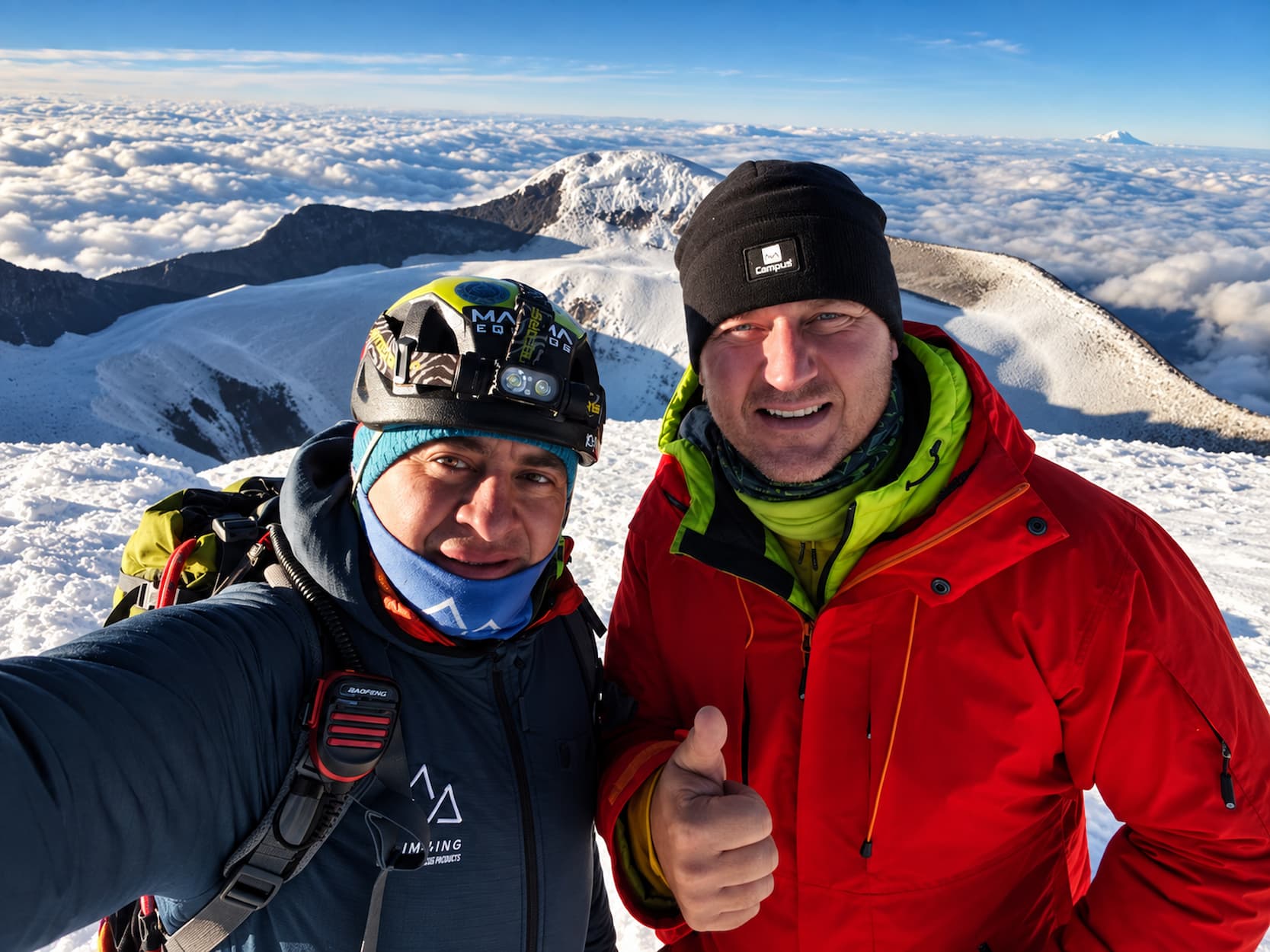
Alpine start, typically around midnight. After a light meal and a final equipment check we move from the refuge onto the glacier, rope up and fit crampons. The route crosses moderate glaciated slopes of 30 to 45 degrees, weaving through the Hermoso Glacier’s crevasse field before the final push to the summit for sunrise. Allow roughly six to seven hours for the ascent and two to three hours to descend. Cayambe is the third highest mountain in Ecuador and the only snow-capped summit in the world sitting directly on the Equator. Everything from the previous two days — rope-team travel, self-arrest readiness, anchors, route judgment — comes together here. After descending to the refuge we collect equipment, leave the mountain and drive east to Papallacta, where volcanic hot springs sit in a cloud-forest valley at approximately 3,300 m / 10,827 ft. Ending the hardest day of the program at lower altitude and in thermal water is part of the recovery plan, not a detour.
- Altitude: Summit 5,790 m / 18,996 ft – overnight at approximately 3,300 m / 10,827 ft
- Accomodation:Papallacta
- Meals: Breakfast
- Distance:120 km
- Duration:12 h
Day 09: Papallacta & Transfer to El Chaupi
Keep the morning deliberately light. Papallacta is yours: rest, eat, dry the equipment and use the thermal pools. A short, easy walk in the surrounding páramo is optional, but there is no scheduled objective and no training session. This is also the debrief on Cayambe with your guide — what worked on the glacier, what was difficult, and what to carry into Chimborazo. In the afternoon we transfer back across the cordillera to El Chaupi and the Ilinizas Mountain Lodge, about three hours on the road. Repack for the Chimborazo stage in the evening, and the guide goes over the plan: the route, the departure time and the turnaround criteria.
- Altitude: Papallacta approximately 3,300 m / 10,827 ft; lodge 3,300 m / 10,827 ft
- Accomodation: Ilinizas Mountain Lodge
- Meals: Breakfast
- Distance: 130 km
- Duration: 3 h
Day 10: Carrel Refuge & Climb to Chimborazo High Camp
Leave the lodge after breakfast and drive south to the Chimborazo Wildlife Reserve, entering the high sand desert where reintroduced vicuñas graze below the mountain. We reach the Hermanos Carrel Refuge at 4,800 m, organize equipment and eat before continuing on foot. The climb to High Camp at approximately 5,300 m takes two to three hours of uphill walking carrying personal equipment. At camp we settle into four-season tents, prepare the summit packs and review the normal-route ascent. Dinner is followed by an early rest period. This is the highest night of the program and the last one before the final climb.
- Altitude: Carrel Refuge 4,800 m / 15,748 ft; High Camp 5,300 m / 17,388 ft
- Accomodation:Chimborazo High Camp (four-season tents)
- Meals: Chimborazo High Camp (four-season tents)
- Distance: 157 km
- Duration: 5-6 h
Day 11: Chimborazo Summit & Transfer to Quito
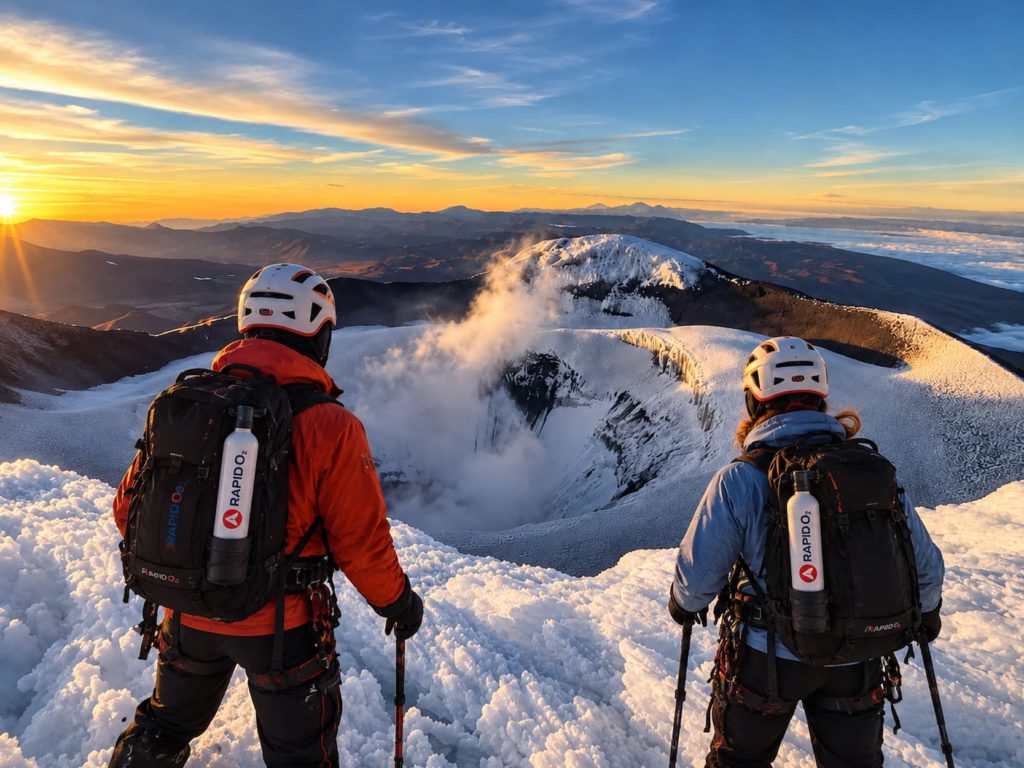
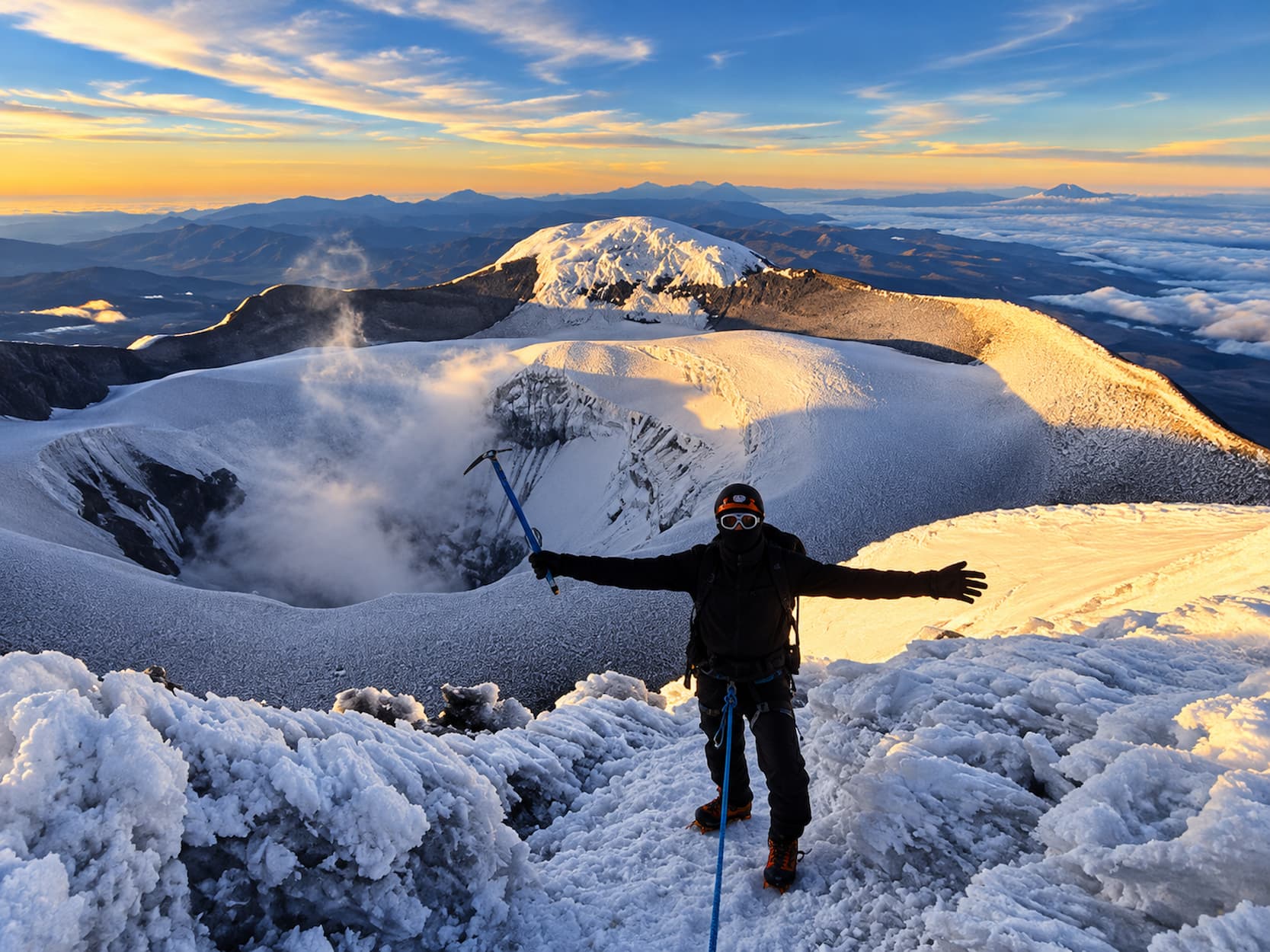
Away at midnight for the summit push on the normal route, as current glacier conditions allow. The objective is Chimborazo’s main summit at 6,268 m / 20,564 ft — because of the equatorial bulge, the point on the planet’s surface farthest from the centre of the Earth. This is the longest and highest day of the program. Allow five to seven hours to the summit including breaks and three to four hours to descend to the refuge. The team climbs at a sustainable pace, with the guide continuously assessing conditions, progress and the energy each climber will need for the return. Reaching the summit remains conditional on a safe ascent and a safe descent. After returning to High Camp we collect personal equipment, descend to the Carrel Refuge and the vehicle, and transfer north to Quito for the final night. The arrival time cannot be fixed in advance.
- Altitude: Summit 6,268 m / 20,564 ft – overnight in Quito, 2,850 m / 9,350 ft
- Accomodation: Hotel in Quito
- Meals: Breakfast,
- Distance: 219 km
- Duration:13-14 h
Day 12: Airport Transfer & Departure
Transfer to Quito International Airport according to your flight schedule, 45 to 60 minutes. Breakfast availability and hotel checkout arrangements are stated in the final booking confirmation. Do not book an international flight for the evening of Day 11. The itinerary reserves Day 12 for departure precisely because the return time from Chimborazo cannot be guaranteed.
- Altitude: 2,850 m / 9,350 ft
- Accomodation: ---
- Meals: Breakfast/-/-
- Distance: 35 km
- Duration:1 h
What's included
Local mountain climbing insurance.
Airport pick-up on Day 1 and airport drop-off on Day 12.
Private ground transportation and all scheduled transfers.
Mountaineering boots (rental available).
Crampons and ice axes.
Climbing harnesses and helmets.
Technical ropes, carabiners and pulleys.
Snow and ice protection equipment, including ice screws, pickets and anchors.
Crevasse rescue and mechanical hauling equipment.
Four-season tents and camping equipment at Chimborazo High Camp.
Technical mountaineering instruction and practical rope systems training.
Glacier travel, ice-axe techniques and crevasse rescue training.
Entrance fees to Los Ilinizas Ecological Reserve.
Entrance fees to Cayambe-Coca National Park.
Entrance fees to Chimborazo Wildlife Reserve.
Mountain refuge reservations, when applicable.
Accommodation throughout the 12-day expedition (11 nights).
Meals as specified in the itinerary.
Not included
International flight tickets
Accommodation in Quito before Day 1 or after Day 12
Meals and drinks in hotels beyond those listed (lunch, dinner) Insurance of any kind: travel accident, health, luggage, trip cancellation
Personal clothing: base layers, down jacket, shell layers, gloves, hat and glacier eyewear
Sleeping bag rental for the refuge and High Camp nights, unless agreed in the written offer
Thermal-bath entrance fees at Papallacta
Snacks, energy gels, energy drinks and similar personal supplies
Tips
Other non-specified expenses
Map
Need help or have a question about this tour?
Our travel expert, who specializes in Ecuador and South America, will personally tailor a high-end itinerary for you.
This will include guided tours designed to provide a fulfilling and enriching experience.
Languages: Espanish | English | Italian | German | François